
Electric Gantry Crane
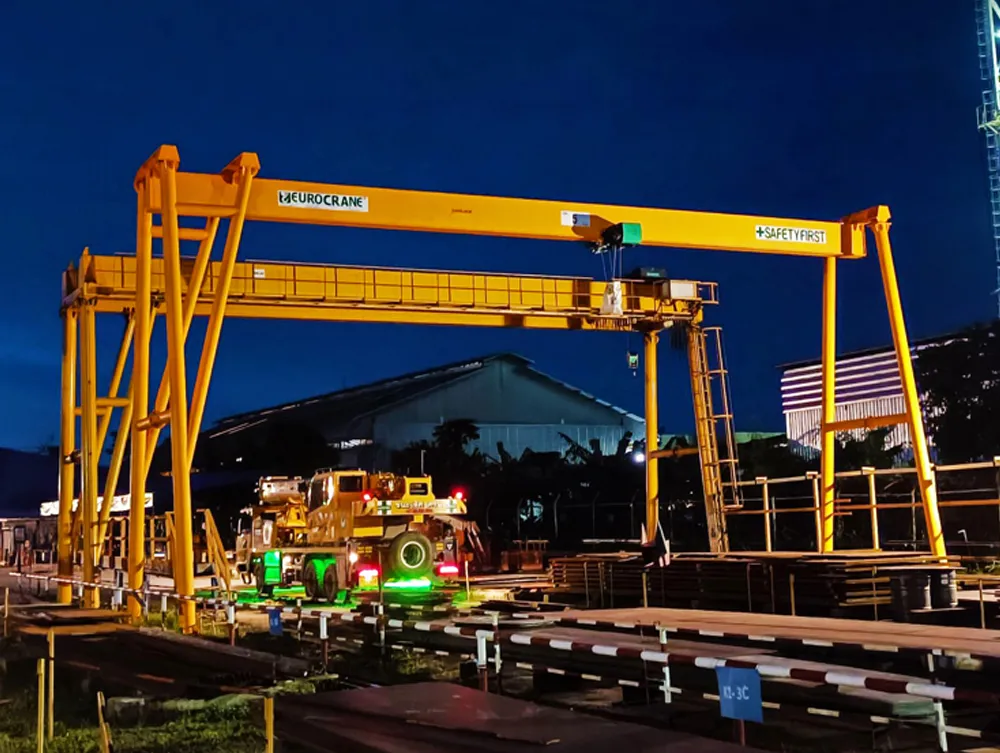
Electric Gantry Crane
Gantry Crane, also known as a Gantry Crane or Portal Crane, is characterized by its elevated leg structure, allowing it to operate independently without relying on the structural framework of a building or factory. It is particularly suitable for outdoor applications, open areas, and large industrial yards.
Key Components of a Gantry Crane
Legs: Two vertical supporting legs that support the Bridge/Girder and are mounted on the longitudinal drive system (End Carriage).
Rigid Leg: A crane leg that is rigidly connected to the Bridge/Girder through a Full Moment Connection, allowing the leg and bridge girder to function as an integrated structural system with high strength and stability (Statically Indeterminate System).
Hinge Leg or Flexible Leg: A crane leg connected to the bridge girder through a Hinge Joint or Ball Hinge, allowing the leg to accommodate slight movement or rotation in response to variations in the runway alignment. This helps compensate for runway irregularities and reduce structural forces during crane travel.
Why Both Rigid and Hinge Legs Are Required
A Gantry Crane is designed with both Rigid Legs and Hinge Legs to accommodate variations in runway alignment during crane travel, particularly in cases where the runway may have irregularities such as bending, misalignment, or non-parallel rails.
The Hinge Leg allows the crane structure to flex and adapt to changes in runway alignment. This helps reduce forces acting on the crane structure and wheel assemblies, allowing the crane to travel smoothly and stably. It also helps minimize the risk of derailment and excessive forces being transferred to the crane structure.
Bridge/Girder: The horizontal beam spanning between the crane legs, supporting the hoist and providing the travel path for the transverse drive system (Trolley).
Hoist and Trolley: The system used to lift and lower loads and move them horizontally along the bridge girder.
End Carriage: The assembly equipped with wheels and a drive system that allows the crane to travel along the runway rails.
Integration with EUROBLOC VT: Helps position the lifting point closer to the crane's centerline for more balanced lifting (Virtually Centered Lifting), maximizing available lifting height and making more efficient use of the available space within the building.